Japanese beetle
Silent SpringThe Japanese beetle is an accidentally imported insect that became a target of expanding eradication campaigns in the United States. Rachel Carson uses its history to expose the costs of defining control as the beetle’s removal at any price: large-scale chemical treatments damaged organisms beyond their intended target, while the beetle’s changing importance and the availability of biological approaches complicated the promise of eradication.
Introduction and Changing Status
Accidentally imported into the United States, the Japanese beetle became the subject of organized efforts to eliminate it. Carson places those efforts against a longer history in which the insect’s status was not fixed: by 1945 it had become a pest of only minor importance throughout much of the territory over which it had spread. That change matters to the control story. A campaign framed as a response to a major threat could continue to demand intervention even as the beetle’s importance diminished.
The contrast is between an insect treated as a permanent emergency and a problem whose significance shifted over time. Carson’s account does not present the beetle’s presence as harmless; instead, it asks what follows when eradication becomes the measure of success, regardless of the effects of the means used.
Chemical Campaigns and Collateral Effects
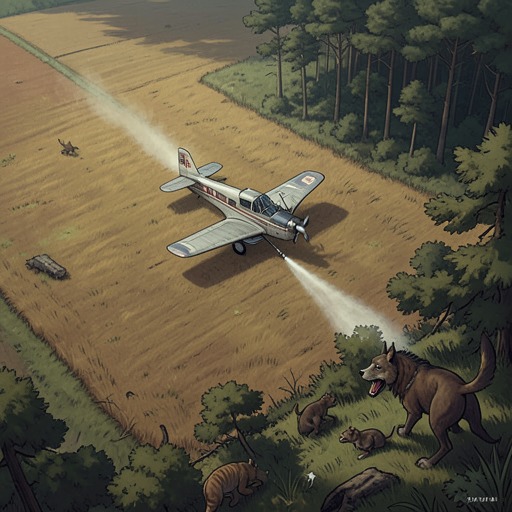
The campaigns could reach far beyond the fields or organisms they were intended to protect. In the fall of 1959, approximately 27,000 acres in southeastern Michigan were treated, including numerous areas beyond the immediate agricultural target. The scale makes the method itself part of the story: the beetle was not pursued only where it threatened crops but through broad-area spraying.
The poison intended for the beetle also affected other organisms. Carson presents the Japanese beetle programs as an example of how chemical control can distribute harm across ecological relationships rather than confining it to a designated pest. The insect’s role as the target therefore does not describe the full consequences of the campaign; non-target life bears part of its cost.
Sheldon, Illinois, is identified as a community that suffered especially heavily in the effort to create a beetle-free world. The phrase captures the disparity between an abstract eradication objective and the local consequences of pursuing it. As more chemical treatments were called for, the treated area had reached approximately 131,000 acres by the end of 1961. The expanding acreage indicates not a completed solution but an intensifying program: each additional treatment enlarged the intervention while leaving open whether the beetle could be permanently eliminated.
Ecological Reversals
The Japanese beetle campaign also belongs to a wider pattern of mass spraying that could upset the populations it was meant to manage. Carson groups spraying for the beetle in the Midwest with the southern fire-ant program as examples of interventions that had precisely this destabilizing effect. In eastern Illinois, after a devastating application of dieldrin for beetle control, farmers found that corn borers had increased. The reversal is central to her account: suppressing one insect could be followed by an increase in another, so success measured solely by the target pest concealed change elsewhere in the agricultural system.
This does not mean that the beetle and the corn borer were identical problems, or that the evidence establishes every step behind the increase. It does show why Carson treats the consequences of spraying as a population-level issue rather than a simple contest between people and a single pest. Chemical treatment could alter the surrounding relations in which insect populations rose or fell, creating new difficulties alongside the original one.
Biological Control and Its Limits
Carson contrasts the chemical campaigns with the longer history of milky disease, a bacterial disease used against the Japanese beetle. In the late 1930s, the discovery and use of this disease provided an early example of controlling a pest by introducing disease into its environment. The disease is caused by spores of a bacterium belonging to the genus Bacillus, and Carson describes the approach as a classic example of bacterial control, with a long history of use in the eastern United States.
The approach was not without ecological questions. Carson notes that the bacterium causing milky-spore disease had been found to infect at least 40 other species of insects. This fact complicates any simple contrast between chemical and biological methods: a biological control agent, too, can affect organisms beyond the named target. The comparison supports a demand for evidence and care in choosing a method, not an assumption that an alternative is automatically harmless.
Research by the United States Department of Agriculture was under way to investigate biological control. Carson sets this work beside the demand for immediate results: those willing to accept any cost for speed, she observes, would doubtless continue using chemicals. The distinction is as much about the measure of success as the tool. Chemical treatment promises direct action, while research and biological control require attention to wider effects and uncertainty. In the beetle’s history, the decisive question is not simply how to kill the target, but whether the chosen method creates consequences that make control more damaging or less stable than the problem it was meant to solve.
Significance
The Japanese beetle links several scales of Carson’s argument: an introduced insect, a pest whose importance changed, communities exposed to extensive spraying, and ecological effects that could emerge beyond the intended target. The acres treated in Michigan and Illinois, the experience of Sheldon, and the increase in corn borers after dieldrin treatment make the costs concrete without reducing them to a single dramatic outcome.
Its history also resists a clean opposition between action and inaction. Milky disease offered a longstanding alternative, but its effects on other insect species demanded scrutiny; chemical campaigns acted quickly, but their expanding scale and unintended consequences undermined the promise of simple eradication. Carson’s account makes the beetle a case for judging control by its effects across the living system, not merely by whether the named pest is attacked.